Northern Wei · Datong
Yungang Grottoes: History & Sacred Art
云冈石窟
Northern Wei cave temples and imperial sculpture outside Datong
Heritage Shanxi editorial team · Updated 2026/08/12
- Date
- From the mid-5th century
- Place
- Datong
- Certainty
- approximate
Why this place matters
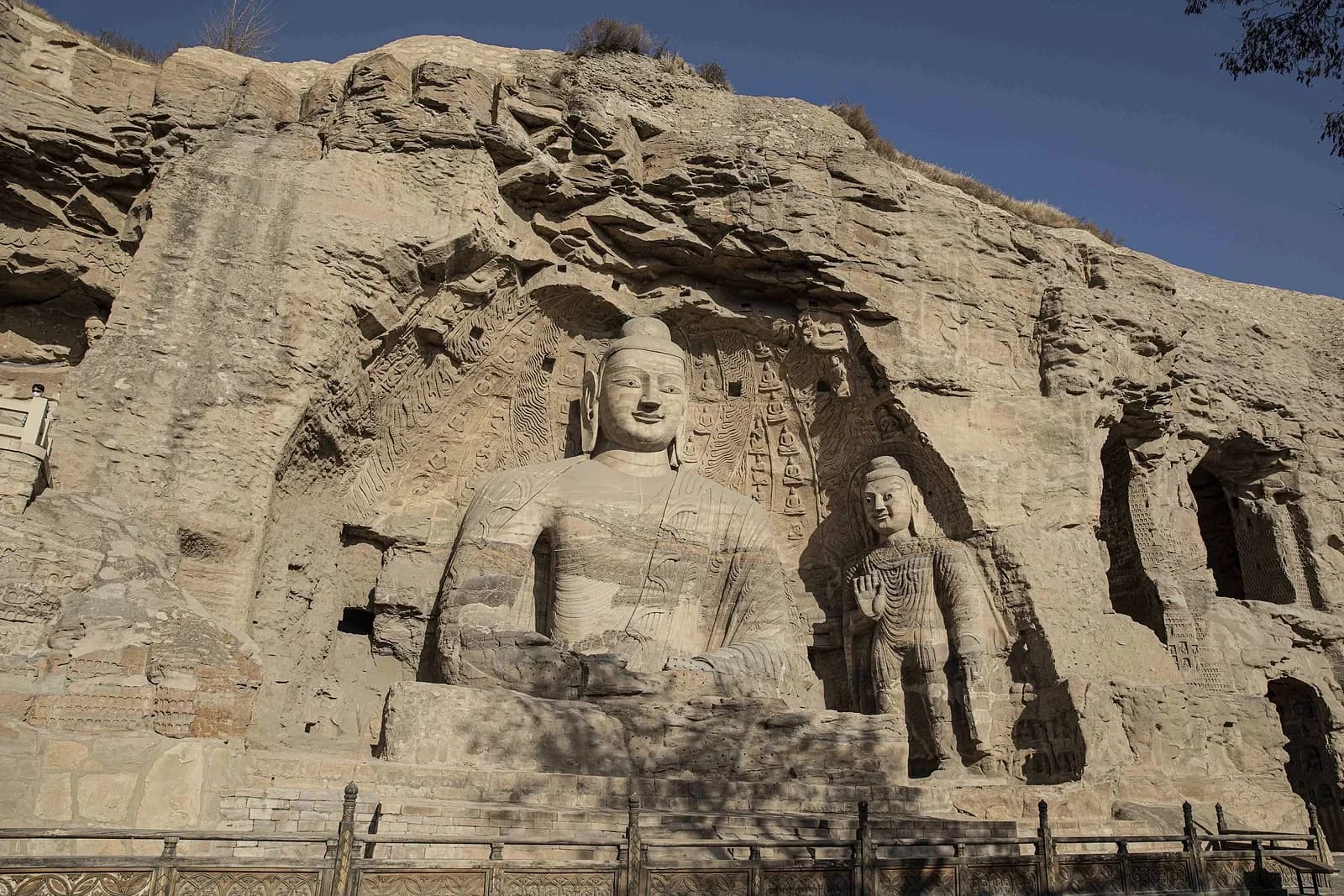
The Yungang Grottoes, carved into the sandstone cliff face near Datong between approximately 460 and 525 CE, are among the earliest major surviving Buddhist cave-temple complexes in China.[1][2] Inscribed on the UNESCO World Heritage List in 2001, the site includes 45 principal caves within a much larger field of grottoes and niches, with over 51,000 individual carved figures ranging from monumental Buddhas nearly 17 metres tall to miniature reliefs.[1] The grottoes were the first major artistic undertaking of the Northern Wei dynasty after the Tuoba court adopted Buddhism as a state religion, and they record how Buddhist imagery arriving through Central Asia was transformed within northern China.
For the educated traveller, Yungang is not merely a collection of sculptures to be admired. It is a reading of how religious art, imperial power and cross-cultural exchange intersect in a single landscape. The caves were carved under direct imperial patronage — some of the colossal Buddhas are traditionally identified as portrait-substitutes for specific Wei emperors, embodying the doctrine that the emperor was a living incarnation of the Buddha.[1][3] This fusion of religious and political authority makes the site one of the clearest surviving demonstrations of how Buddhism was adapted to serve dynastic legitimacy in early medieval China.
The grottoes also hold a pivotal position in the global history of Buddhist art. Scholars identify Indian and Central Asian influences in the sculptural styles visible at Yungang, filtered through the workshops of the Northern Wei and rendered in a language that would, within a few generations, become recognisably Chinese. The site is thus a cultural crossroads rendered in stone.
Architecture in the field
Although rock-cut rather than timber-built, the caves at Yungang belong in an architectural narrative because they were conceived as architecture: they organise approach, enclosure, scale, light and the movement of the worshipper through carved space. The visitor enters a sequence of chambers carved from the cliff, some open to the sky, others deep and shadowed, and in each the relationship between figure, wall and chamber creates a distinct spatial argument.
The earliest and most monumental group of caves are Caves 16 through 20, traditionally known as the Tan Yao Five Caves (Tanyao Wuku), after the monk Tan Yao who directed their construction under Emperor Wencheng.[1][3] These five caves, each centred on a colossal seated Buddha, represent the imperial portrait tradition: each Buddha is traditionally associated with one of the first five Northern Wei emperors, embodying the identification of the ruler with the Buddha. The Buddhas range from approximately 13 to nearly 17 metres in height, and their sheer scale — encountered in a relatively small chamber — creates an experience of awe and compression that is fundamental to the caves' religious effect. The carving style of these early caves is robust and frontal, with broad faces, heavy drapery and a powerful sense of mass; some scholars have identified specific Gandharan and Central Asian influences in the drapery folds and facial features, reflecting the presence of foreign artisans in the Wei workshops.
Later caves, carved in the 480s and 490s under Emperor Xiaowen, show a stylistic shift toward what scholars have called the "Sinicisation" of Buddhist art.[1][3] As the Wei court adopted Chinese cultural practices — including Chinese dress, language and bureaucratic forms — the sculpture at Yungang followed suit: the Buddhas become slimmer and more elongated, the drapery more linear and flowing, the faces more refined and less emphatically non-Chinese. Caves 5 and 6, dating from this later phase, are among the most richly decorated: Cave 6 in particular is a tour de force of carved narrative, with hundreds of relief panels depicting episodes from the Buddha's life arranged across every available surface, from floor to ceiling.
Beyond the major caves, the site preserves numerous smaller caves, niches and thousands of independent carvings scattered across the cliff face — a record of patronage by officials, monks and lay believers of lesser means. These smaller works, often overlooked by visitors focused on the monumental caves, provide a rich archive of devotional practice and artistic style across the full span of the site's active carving period.
Open questions in the scholarship
The identification of the Tan Yao Five Caves with specific emperors remains a subject of scholarly debate. The traditional account, based on later historical texts, assigns each of the five colossal Buddhas to one of the first five Wei emperors, but the evidence is circumstantial — there are no inscriptions within the caves themselves that confirm these identifications.[1][3] Some scholars have proposed alternative correspondences or have questioned whether the imperial portrait doctrine was as systematic at Yungang as later texts suggest. The question matters because the Yungang identification of emperor and Buddha became a template for later Chinese Buddhist art, and understanding how literally it was applied at its origin affects how scholars interpret later caves and sculptures.
The question of foreign versus indigenous artistic agency is also unresolved. While the presence of Central Asian and Indian stylistic elements at Yungang is well documented, the specific role of foreign artisans — whether they carved the figures directly, supervised Chinese workmen, or simply provided design models that Chinese carvers executed — remains a matter of inference rather than direct evidence. The lack of inscriptional records naming individual sculptors or workshops makes it difficult to reconstruct the creative process behind the caves with any precision.
A further area of active concern is conservation. The sandstone into which the caves are carved is soft and porous, making it vulnerable to weathering, water infiltration and freeze-thaw cycles. Over the past century, industrial pollution from Datong's coal-mining economy has accelerated surface erosion, prompting large-scale conservation interventions including protective shelters, drainage systems and, in some cases, consolidation treatments of the stone surface.[1] The tension between preservation and presentation — how to protect the caves while keeping them accessible to the public and visible in their original cliff-side setting — is an ongoing challenge that conservation teams from UNESCO and the Chinese heritage authorities continue to address.
Sources
- "Yungang Grottoes," UNESCO World Heritage Centre, https://whc.unesco.org/en/list/1039/, accessed 2026-07-16.
- "Yungang Grottoes," Wikipedia, accessed 2026-07-18.
- Su Bai (宿白), Zhongguo shiku yishu (中国石窟艺术: Yungang) — Chinese archaeological scholarship on the caves' chronology, patronage and stylistic development.
- Angela F. Howard, "The Imagery of the Tan Yao Caves and the Northern Wei State Buddhism" and related studies in Chinese Buddhist art history — for the imperial portrait tradition and the Sinicisation debate.
- Chinese State Administration of Cultural Heritage (国家文物局) conservation reports and Yungang Grottoes Research Institute publications, for structural condition and conservation interventions.
References
- 1. Yungang Grottoes, UNESCO World Heritage Centre. whc.unesco.org