Yuan · Yuncheng
Yongle Palace: History, Architecture & Murals
永乐宫
Yuan-dynasty Daoist halls and murals in Ruicheng, with relocation part of the record
Heritage Shanxi editorial team · Updated 2026/08/24
- Date
- From the 13th century · Yuan
- Place
- Ruicheng County
- Certainty
- multiple periods
Why this place matters
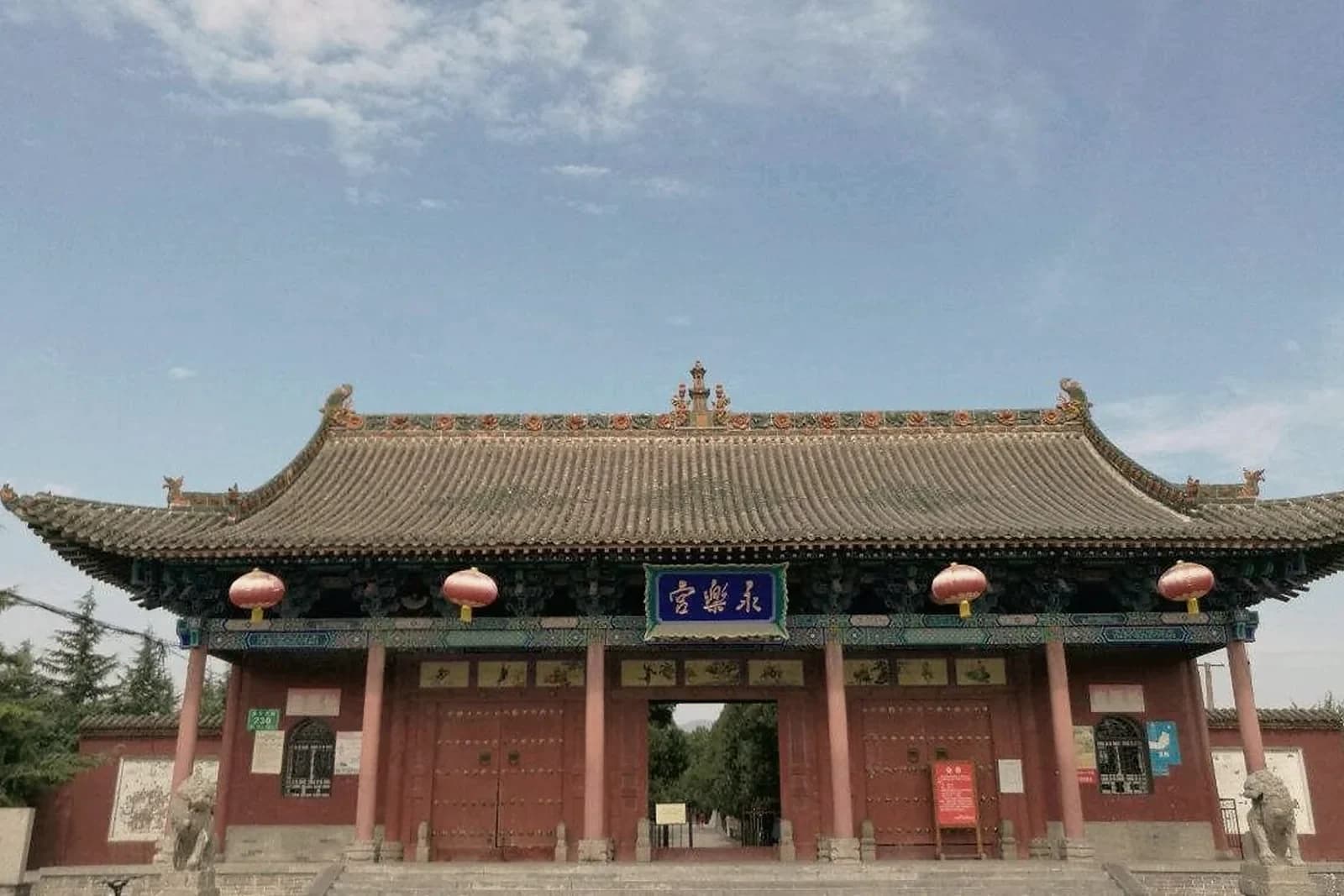
Yongle Palace makes the relationship between architecture and monumental wall painting impossible to ignore. Standing near Ruicheng County in southern Shanxi, close to the Yellow River, it is one of the major surviving Daoist temple complexes of the Yuan dynasty, built in honour of Lü Dongbin — the immortal traditionally held to have been born in this area.[1][2] Construction began in 1247 and continued, with interruptions, for well over a century, under the patronage of the Quanzhen school of Daoism, which enjoyed imperial favour in the early Mongol period.[2]
The palace's second claim on attention is its painted programme: nearly one thousand square metres of murals survive across its principal halls, among the largest and most important groups of monumental wall painting from the Yuan dynasty anywhere in China.[1][2] The complex was designated a nationally protected monument in the first round of such listings in 1961, a mark of its standing in the country's conservation history.[3]
Architecture in the field
The complex is best read as a progression. Along its central axis the visitor passes through a sequence of gates and halls, each enclosing painted interiors of changing scale and subject. The spatial discipline matters: Yuan temple planning here works through ordered enclosure and controlled approach, not through a single spectacular facade. Compare the bays, roof forms and structural proportions of the halls as you move through them — their carpentry is a coherent Yuan-dynasty document in itself, with bracketing and framing that belong to the same building tradition as the other great thirteenth- and fourteenth-century halls of southern Shanxi.[2]
The murals are the reason most visitors come, and they should be read hall by hall rather than as one decoration. The Sanqing Hall (Hall of the Three Pure Ones), the principal hall, preserves the largest scheme: a vast, ordered assembly of Daoist deities rendered at monumental scale, its composition and line-work studied as masterpieces of Yuan religious painting.[1][2] The Chunyang Hall carries a narrative cycle depicting scenes from the life and legend of Lü Dongbin — a painted biography that doubles as a picture of streets, buildings and daily life in the period that produced it, which makes it a source for architectural and social history as well as religion.[2] The Chongyang Hall continues the programme with scenes associated with Wang Chongyang and the founding patriarchs of the Quanzhen school.[2]
Taken together, the painted interiors show how a Yuan Daoist institution staged its cosmology: architecture defining the sequence, painting filling each space with a specific register of the sacred. Few surviving sites let that relationship be studied at this scale.
Relocation is part of the record
The complex as visited today does not stand on its original ground. In the late 1950s and early 1960s, facing inundation by the reservoir of the Sanmenxia Dam on the Yellow River, Yongle Palace was carefully documented, dismantled, moved to higher ground nearby and re-erected — one of the most ambitious building relocations in China's conservation history.[1][2]
That relocation is part of the monument's record, not something to smooth over. The halls stand with their historic timber frames and mural surfaces, but their setting, foundations and relationship to the original landscape are the result of a twentieth-century conservation decision. An honest field reading keeps three layers distinct: the Yuan-period fabric of the halls and paintings, the documented history of the move, and the present landscape that now surrounds them. This is the same discipline applied everywhere on this site — present setting, historic fabric and conservation history are not collapsed into one misleading idea of originality.
Editorial note
Detailed mural attribution, conservation reports from the relocation and subsequent campaigns, practical access and photography remain under source and rights review.
Sources
- "Yongle Palace," Wikipedia, accessed 2026-08-24.
- Steinhardt, Nancy Shatzman. Chinese Architecture in an Age of Turmoil, 960–1368, University of Hawaii Press — for Yuan temple planning and structural context.
- State Administration of Cultural Heritage, First Batch of Major Historical and Cultural Sites Protected at the National Level (第一批全国重点文物保护单位), 1961.
References
- 1. Yongle Gong, Wikipedia. en.wikipedia.org
- 2. Yongle Palace in Ruicheng, China Daily (Shanxi). shanxi.chinadaily.com.cn