Ming · Qing · Jinzhong
Pingyao Ancient City: Urban Form & Architecture
平遥古城
Reading a walled Ming–Qing town as one urban system
Heritage Shanxi editorial team · Updated 2026/08/24
- Date
- Ming–Qing urban fabric
- Place
- Pingyao County
- Certainty
- multiple periods
Why this place matters
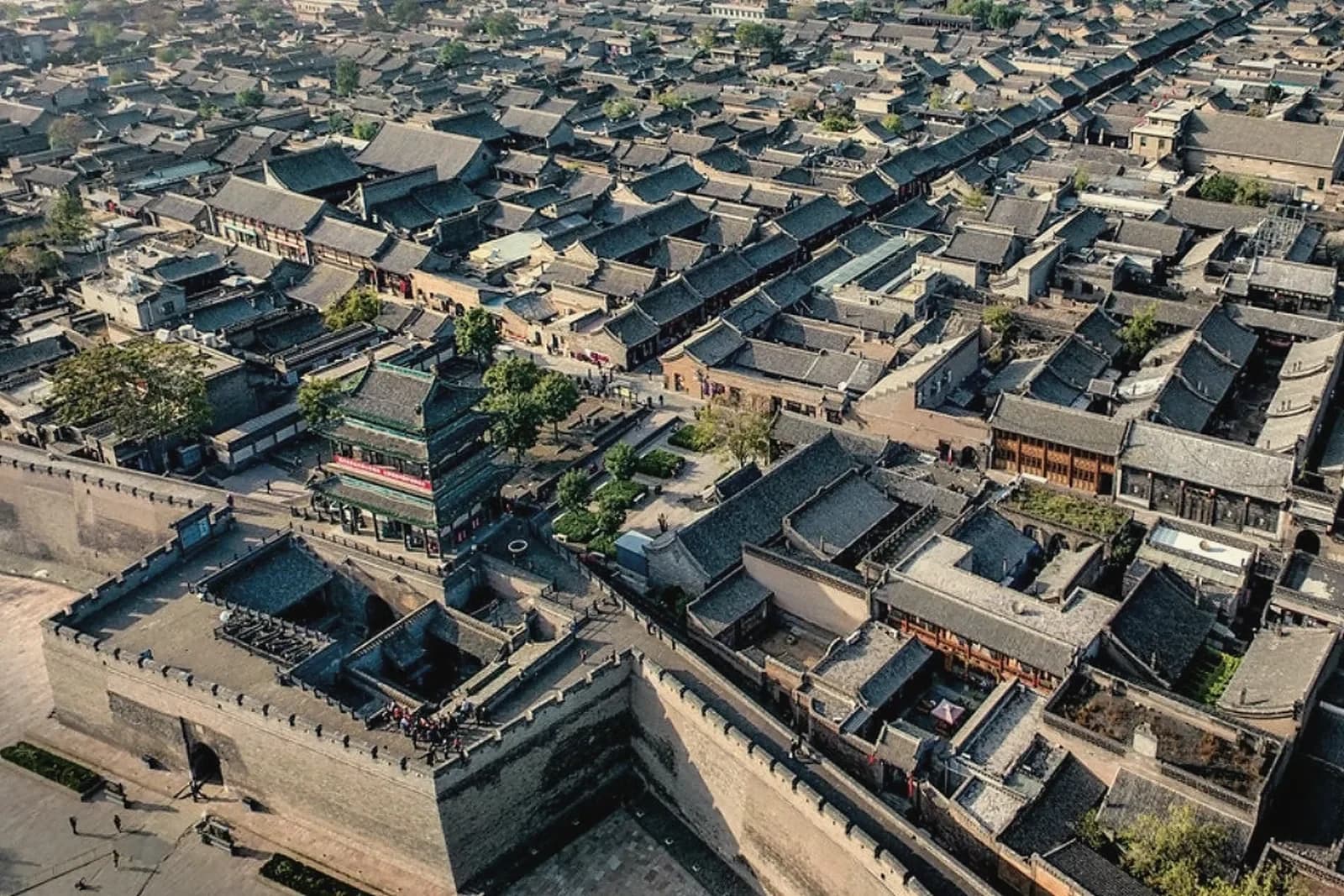
Pingyao changes the scale of the architectural question. Instead of one hall or tower, the surviving record is urban: walls, streets, shops, institutions, temples and courtyard buildings work together as a historic town. Inscribed as a UNESCO World Heritage property in 1997, the Ancient City of Ping Yao is recognised as an exceptionally complete example of a Han Chinese county seat from the Ming and Qing periods — a city that retained its pattern of streets, plots and buildings into the modern era rather than being rebuilt around them.[1]
The city's significance also runs through money as much as architecture. In the nineteenth century, Pingyao was the centre of China's draft-bank (piaohao) network: institutions that moved funds across the empire by written draft rather than physical silver. Rishengchang, founded in 1823, is generally credited as the first of these banks, and several of its contemporaries still stand as museums within the city wall.[2] For several decades, decisions made in Pingyao's counting houses shaped credit across Qing China — an economic history that is part of the city's architectural story, because the banks, their vaults, courtyards and fortified shopfronts are still legible in the streetscape.
Architecture in the field
Begin with the wall. The present circuit was built in 1370, early in the Ming dynasty, brick-facing an older rammed-earth core; it runs roughly six kilometres around the city, carries six gates and is studded with watchtowers, a defensive envelope that fixed the city's footprint for the centuries that followed.[1][2] From the wall the city reads as a single organism: a compact grid of lanes, with the main north-south commercial street as its spine.
Then read the street. The commercial frontages follow a repeated rule — shop rooms at the street edge, progressively deeper courtyards behind, moving from public trade to private family life through a sequence of thresholds. Individual facades matter, but the city becomes legible through these repeated spatial rules: the rhythm of plots, the height discipline of the lanes, the way courtyards stack behind narrow frontages. It is urban design as convention rather than as a single authored plan, and that is precisely what the World Heritage inscription values: the city shows how a Chinese county seat was planned, inhabited and adapted over five centuries.[1]
The draft banks deserve close attention as a building type. Their architecture combined display and defence: presentable street elevations for customers, compact vault structures and guarded inner courts for silver and ledgers. Visiting one after another makes it possible to compare how different houses solved the same problems — security, hierarchy, residential comfort — within the same urban grammar.[2]
Religious and civic buildings fill out the record: the city temple and county offices, market towers and neighbourhood shrines give the town its institutional depth. They should be read as working parts of the city rather than as isolated monuments.
A living historic city
Pingyao is not a sealed architectural specimen. People live inside the wall; conservation, tourism, residence and commerce all shape what a visitor encounters. Some buildings are documented historic fabric; others are restored, adapted or presented for visitors, and the honest reading separates these categories rather than collapsing them into one idea of an "ancient city".[1] The city's conservation history — including the pressures of tourism growth since World Heritage inscription — is itself part of its record, and it mirrors debates happening in living historic cities across China and beyond.
For the field visitor, the discipline is the same as for the single hall: identify what is dated and documented, notice what has been renewed, and enjoy the town without pretending it stopped at any particular moment.
Editorial note
Detailed building-by-building dating, conservation intervention history and photography rights remain under source review. Practical visiting information should be checked against current official sources before travel.
Sources
- "Ancient City of Ping Yao," UNESCO World Heritage Centre, https://whc.unesco.org/en/list/812/, accessed 2026-08-24.
- "Pingyao," Wikipedia, accessed 2026-08-24 — for the city wall, urban layout and the piaohao history including Rishengchang.
References
- 1. Ancient City of Ping Yao, UNESCO World Heritage Centre. whc.unesco.org